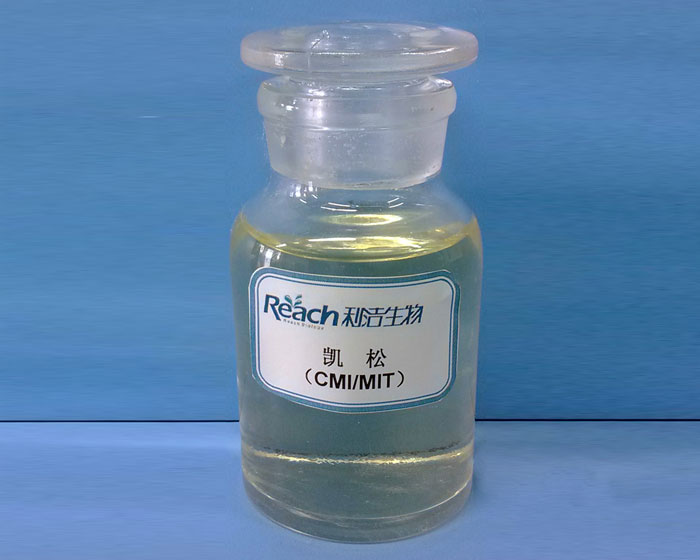
Kathon 14%, 3.0%, 1.5% Aqueous Solutions (Kathon CG)

Kathon Chemical Structure

I. Product Information

Product Name Kathon 14%, 3.0%, 1.5% Aqueous Solutions
Synonyms Kathon CG / Kathon 886 / CMIT-MIT
Chemical Name 5-Chloro-2-methyl-4-isothiazolin-3-one (CMIT) and 2-methyl-4-isothiazolin-3-one (MIT) mixture
English Name 5-chloro-2-methyl-4-isothiazolin-3-one / 2-methyl-4-isothiazolin-3-one mixture
Molecular Formula C₄H₄ClNOS (CMIT) / C₄H₅NOS (MIT)
Molecular Weight 149.59 (CMIT) / 115.14 (MIT)
CAS No. 26172-55-4 (CMIT) / 2682-20-4 (MIT)
EC Number 247-500-7 / 220-239-6

II. Product Properties

Property Description
Appearance Yellow or yellow-green transparent liquid (14%) / Colorless to amber liquid (3.0%, 1.5%)
Antimicrobial Spectrum Broad-spectrum, long-acting bactericide against bacteria, fungi, yeast, and algae; especially effective against Pseudomonas
Mechanism Reacts with sulfur-containing proteins in microbial cells, inhibiting cellular respiration and energy metabolism, leading to cell death
Stability Stable at pH 2~9; effective in both acidic and alkaline water; compatible with oxidizing biocides (e.g., chlorine), scale inhibitors, dispersants, and most surfactants with synergistic effects
Solubility Completely miscible with water; soluble in lower alcohols, glycols, and polar organic solvents
Physical & Chemical Data:
  • Active Ingredient Content: 14.0%~14.5%, 3.0%~3.1%, 1.5%~1.6%
  • CMIT/MIT Ratio (Chlorine Ratio): 2.5~3.5 (typically 3:1)
  • pH: 2.0~4.0 (concentrate) / 1.0~4.0 (various grades)
  • Density: 1.27~1.33 g/mL (20℃)
  • Boiling Point: 200.2℃ (pure)
  • Flash Point: 74.9℃ (pure)
  • lgKow: 1.547 (hydrophilic)

III. Quality Specifications

Test Item Specification Method
Appearance Yellow or yellow-green transparent solution Visual
Active Ingredient 14.0%/3.0%/1.5% HPLC
CMIT/MIT Ratio 2.5~3.5 HPLC
pH 2.0~4.0 pH Meter
Density (20℃) 1.27~1.33 g/mL Densitometry
Heavy Metals (as Pb) ≤0.001% Colorimetric
Arsenic (As) ≤0.0001% AAS
Stability Stable at pH 2~9 pH Stability Test
Identification IR spectrum and retention time match reference standard FTIR, HPLC
Note: Custom concentrations (14%, 1.5%, etc.) and adjustable CMIT/MIT ratios available upon request.

IV. Antimicrobial Performance (MIC Data)

Microorganism MIC (mg/L) Microorganism MIC (mg/L)
E. coli 10~50 Pseudomonas aeruginosa 20~100 (Effective)
S. aureus 10~50 Bacillus subtilis 20~100
Aspergillus niger 50~200 Saccharomyces cerevisiae 50~200
C. albicans 50~200 Algae 10~50
Sulfate-reducing bacteria 20~100 Iron bacteria 20~100
Slime-forming bacteria 10~50 Legionella 10~50
Note: Kathon is especially effective against Pseudomonas, a distinguishing feature from other preservatives; effective across a wide pH range (2~9).

V. Applications

1. Industrial Water Treatment (Core Application)
  • Cooling water systems: Petrochemical, metallurgical, power generation, HVAC, and industrial recirculating cooling water systems for biocidal and algaecidal treatment, effectively inhibiting microbial growth
  • Oilfield water injection: Prevents corrosion and plugging caused by sulfate-reducing bacteria, iron bacteria, and slime-forming bacteria
  • Usage: Dilute to 1.5% aqueous solution; add 1-2 times weekly at 80-100 ppm depending on biofouling conditions
  • Restriction: Not suitable for cooling water systems containing sulfides
2. Papermaking Industry
  • Pulp preservation: Prevents microbial contamination
  • Paper machine white water: Biocidal treatment
  • Coating preparation: Preservation
3. Coatings & Adhesives
  • Water-based coatings: Anti-mold and preservation
  • Adhesives: Prevents microbial degradation
  • Inks/Dyes: Preservation
  • Feature: Excellent compatibility with various emulsifiers, surfactants, and protein components
4. Metalworking
  • Metal cutting fluids: Preservation (same PT-13 type as PHMB)
  • Metalworking oils: Prevents microbial deterioration
5. Cosmetics & Personal Care (Restricted Use)
  • Historical use: Previously widely used in shampoos, body washes, etc.
  • Current regulations: China "Cosmetics Safety Technical Specifications" restricts CMIT/MIT mixtures to max 0.0015% (rinse-off only); MIT alone max 0.01%
  • Note: EU has banned CMIT/MIT mixtures in leave-on cosmetics; MIT also banned in leave-on products
6. Other Industries
  • Textile auxiliaries: Preservation
  • Paraffin wax emulsions: Preservation
  • Wood: Anti-mold treatment

VI. Regulatory Compliance & Safety

Certification/Regulation Details
China Cosmetics Regulations "Cosmetics Safety Technical Specifications" 2015: CMIT/MIT mixture max 0.0015% (rinse-off only); MIT alone max 0.01%
EU Regulations EC No 1223/2009: CMIT/MIT mixtures prohibited in leave-on cosmetics; MIT prohibited in leave-on cosmetics
Industrial Applications Widely used in industrial water treatment, papermaking, coatings without special restrictions
Test Standards GB/T 29666-2013 "Cosmetics Preservatives - Mixture of Methylchloroisothiazolinone and Methylisothiazolinone with Magnesium Chloride and Magnesium Nitrate"
Toxicity Data:
Endpoint Data
Acute Oral LD₅₀ (Rat) 2000~5000 mg/kg (Low toxicity)
Skin Irritation Concentrate is irritating; use concentration is harmless
Sensitization Strong sensitizer; may cause allergic contact dermatitis
Aquatic Toxicity Biodegradable to non-toxic substances; no environmental hazard
Safety Precautions:
  • Concentrate is irritating to skin and eyes; wear protective equipment during handling
  • Strong sensitizer; avoid direct skin contact
  • Not suitable for cooling water systems containing sulfides
  • Enhanced efficacy when combined with quaternary ammonium salts

VII. Packaging & Storage

Packaging: 25kg/plastic drum, 250kg/plastic drum, 1250kg/IBC tote; custom sizes available
Storage: Cool, dry place (≤25°C), sealed, away from light; avoid strong alkalis, sulfides, and strong reducing agents
Shelf Life: 12 months (sealed)
Transport: General chemical (corrosive, sensitizing); handle with care to prevent damage

VIII. Key Advantages

Copyright: Hunan LiJie Biotech Group Co., Ltd.  湘ICP备14008251号-1   Powered by Shixin CMS