Polyhexamethylene Guanidine Hydrochloride (PHMG)

PHMG Chemical Structure

I. Product Information

Product Name Polyhexamethylene Guanidine Hydrochloride
Synonyms PHMG / PHGC
Chemical Name Polyhexamethylene Guanidine Hydrochloride
English Name polyhexamethyleneguanidine hydrochloride
Molecular Formula (C₇H₁₅N₃)ₘ·(HCl)ₙ, m/n=1~2
Molecular Weight 1000~3000 (Average)
CAS No. 57028-96-3
EC Number 27083-27-8 (Related)

II. Product Properties

Property Description
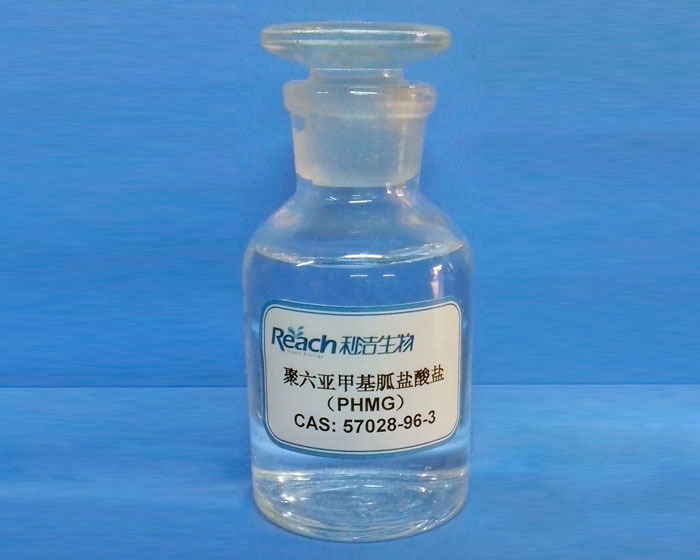
Appearance White amorphous powder or resinous polymer (pure); colorless to pale yellow transparent liquid (25% aqueous solution)
Antimicrobial Spectrum Broad-spectrum efficacy against Gram-positive/negative bacteria, fungi, yeast, and viruses; >99.98% kill rate in 1 minute
Mechanism ① Cationic polymer adsorbs anionic microorganisms, inhibiting cell division; ② Forms film blocking respiratory channels causing asphyxiation
Stability High chemical stability; antimicrobial efficacy increases with polymerization degree, significantly superior to low-molecular-weight guanidines (e.g., chlorhexidine)
Solubility Highly soluble in water; compatible with anionic, non-ionic, and cationic surfactants
Physical & Chemical Data:
  • Boiling Point (25% solution): 102~103℃
  • Relative Density (20℃, 25% solution): 1.045~1.055
  • pH (20℃, 25% solution): 5.0~7.0
  • Solid Content: 25% (standard commercial grade)
  • Residual Hexamethylenediamine: Not detected

III. Quality Specifications

Test Item Specification Method
Appearance White amorphous powder or resinous polymer (pure) / Colorless to pale yellow transparent liquid (25% solution) Visual
Solid Content 25.0%±1.0% (aqueous solution) Gravimetric
pH (25% solution) 5.0~7.0 pH Meter
Average Molecular Weight 1000~3000 GPC
Relative Density (20℃) 1.045~1.055 Densitometry
Residual Hexamethylenediamine Not detected HPLC
Heavy Metals (as Pb) ≤0.002% Colorimetric
Arsenic (As) ≤0.0001% AAS
Identification IR spectrum matches reference standard FTIR
Note: Custom concentrations (25%, 50%) and molecular weight grades available upon request.

IV. Antimicrobial Performance (Bactericidal Efficacy)

Microorganism Contact Time Kill Rate/% Test Conditions
E. coli 1min 99.98 (22±1)℃, positive control 6.53×10⁶ cfu/mL
E. coli 2min 100 As above
E. coli 5min 100 As above
E. coli 10min 100 As above
S. aureus 1min 99.99 Positive control 5.40×10⁶~7.74×10⁶ cfu/mL
S. aureus 2min 100 As above
S. aureus 5min 100 As above
S. aureus 10min 100 As above
C. albicans 1min 99.99 Positive control 6.85×10⁶ cfu/mL
C. albicans 2min 100 As above
C. albicans 5min 100 As above
C. albicans 10min 100 As above
Note: PHGC demonstrates excellent antimicrobial activity: >99.98% kill rate against E. coli, S. aureus, and C. albicans within 1 minute; 100% kill within 2 minutes. Effective inhibition of Staphylococcus, Salmonella, and Escherichia. Concentration 0.001%~0.1% for 5-10 minutes provides excellent bactericidal efficacy.

V. Applications

1. Water Treatment & Public Health
  • Drinking water disinfection: tap water, well water, spring water sterilization and algae control
  • Swimming pools/lakes/ponds: water body sterilization and algae removal
  • Cooling towers/fountains: industrial circulating water system treatment
  • Wastewater treatment: used as flocculant
  • Water supply/drainage/heating pipelines: sterilization treatment with minimal human toxicity
2. Beverage & Food Processing
  • Beverage industry: production equipment and pipeline disinfection
  • Food processing: workshop environment and equipment surface sanitation
3. Petroleum & Industrial
  • Petroleum extraction: oil well and water injection system biocide
  • Livestock facilities: agricultural breeding environment disinfection
  • Metal corrosion: weak corrosion to stainless steel, copper, and carbon steel
4. Textile & Paper
  • Textile industry: fiber and fabric antimicrobial finishing
  • Paper industry: pulp preservation and antimicrobial paper treatment
  • Dosage: 0.01%~2.0% (paper surface antimicrobial treatment)
5. Wood & Building Materials
  • Wood processing: antiseptic and anti-mold treatment
  • Cement mortar: cement-sand-water-PHMG mortar (0.01%~2% of cement weight) effectively prevents biodeterioration caused by fungi and microorganisms
6. Agriculture
  • Agricultural biocide: crop protection and soil disinfection
7. Household & Medical Cleaning
  • Disinfectant formulation: PHMG (7.0%~9.0%), alkyl diphenylamine chloride (9.0%~11.0%), coconut fatty acid diethanolamide (1.0%), ethanol (18.0%~22.0%), ammonium chloride (5.0%), citric acid (12.0%)
  • Applications: medical items, disinfection washing equipment, tableware, linen cleaning and disinfection
8. Footwear & Leather
  • Antimicrobial insoles: PHMG-containing insoles and foot adhesives as bactericide and antifungal agent; prevents foot mycosis, reduces pathogenic fungi on skin without altering skin microbiome
9. Cultural Heritage Conservation
  • Artifact preservation: antifungal agent for conservation of prints and manuscripts, preventing biodeterioration
10. Composite Materials
  • Antimicrobial guanidine clay: PHGC combined with alkaline clay via hydrogen bonding; applied in starch/PVA composite films
  • Performance: 99% kill rate against E. coli; optimal addition 2%; increases tensile strength by 60% and elongation at break by 29%; exhibits clear inhibition zones

VI. Regulatory Compliance & Safety

Certification/Regulation Details
Toxicity Data Acute oral LD₅₀ (mice): >10,000 mg/kg body weight (practically non-toxic)
Skin Irritation Rabbit skin irritation index: 0; irritation level: non-irritant
Skin Sensitization Very weak skin sensitization in guinea pigs
Genotoxicity No micronucleus induction in mouse bone marrow polychromatic erythrocytes
Polymer Safety High-molecular-weight polymers poorly absorbed by animal tissues; toxicity decreases with increasing polymerization degree; minimal effect on higher organism cells
Metal Corrosion Weak corrosion to stainless steel, copper, and carbon steel
Environmental Properties Low toxicity, non-irritating, non-sensitizing, biodegradable
Safety Advantages:
  • Increasing polymerization degree → decreasing toxicity → minimal effect on higher organism cells
  • Increasing polymerization degree → increasing antimicrobial efficacy → high efficiency with low toxicity
  • Superior safety and efficacy compared to low-molecular-weight guanidines (e.g., chlorhexidine)

VII. Packaging & Storage

Packaging: 25kg/drum (25% solution) / 20kg/fiber drum (pure powder); custom sizes available
Storage: Cool, dry place (≤25°C), sealed, away from light; avoid strong alkalis and oxidizers
Shelf Life: 24 months (sealed)
Transport: General chemical; handle with care to prevent damage

VIII. Key Advantages

Copyright: Hunan LiJie Biotech Group Co., Ltd.  湘ICP备14008251号-1   Powered by Shixin CMS