| Property | Description |
|---|---|
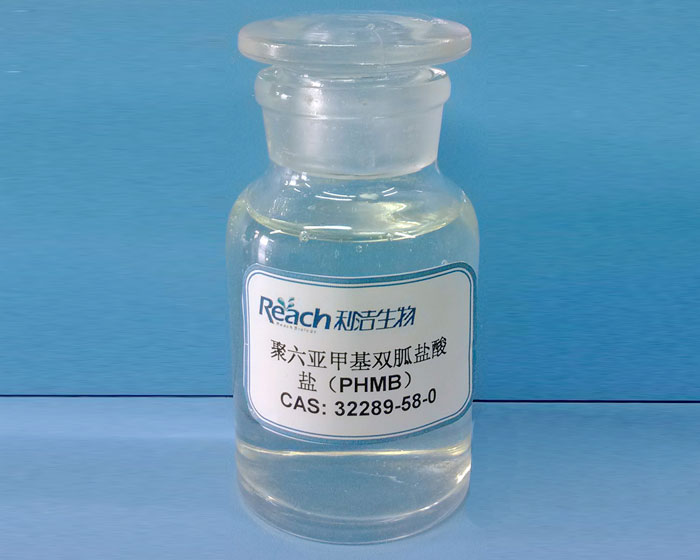
| Appearance | White powder (pure); colorless to pale yellow translucent liquid (20% aqueous solution) |
| Antimicrobial Spectrum | Broad-spectrum efficacy against Gram-positive/negative bacteria, fungi, yeast, viruses, and spores |
| Mechanism | ① Cationic polymer adsorbs anionic bacteria, inhibiting cell division; ② Disrupts cell membrane forming transmembrane pores; ③ Forms film blocking microbial respiration |
| Stability | Stable at pH 4-10; heat stable; non-volatile; thermally durable active component |
| Solubility | Highly soluble in water; compatible with non-ionic surfactants, glycols, EDTA, and strong acids |
| Test Item | Specification | Method |
|---|---|---|
| Appearance | White powder (pure) / Colorless to pale yellow translucent liquid (20% solution) | Visual |
| Solid Content | 20.0%±1.0% (aqueous solution) | Gravimetric |
| pH Value | 4.0~6.0 (20% solution) / 6.5~8.5 (1% solution) | pH Meter |
| Avg. Molecular Weight | 1100~1800 | GPC |
| Polymerization Degree | n=12~16 | Viscometry |
| Absorbance (237nm) | ≥400 | UV Spectrophotometry |
| Absorbance Ratio (237/222nm) | 1.2~1.6 | UV Spectrophotometry |
| Heavy Metals (as Pb) | ≤0.002% | Colorimetric |
| Arsenic (As) | ≤0.0001% | AAS |
| Identification | IR spectrum matches reference standard | FTIR |
| Microorganism | MIC (mg/L) | Microorganism | Bactericidal Effect | Conc. (%) | Time (min) |
|---|---|---|---|---|---|
| Staphylococcus aureus | 1 | S. aureus | Kill | 0.025 | >1 |
| E. coli O157:H7 | 5 | E. coli | Kill | 0.2 | >1 |
| Bacillus spp. | 5 | B. subtilis spores | Kill | 0.05 | >1 |
| Salmonella typhimurium | 8 | S. typhimurium | Kill | 0.04 | - |
| Proteus vulgaris | 200 | P. aeruginosa | Kill | 0.2 | >3 |
| P. putida | 25 | Lactobacillus homohiochii (4 strains) | Kill | 0.002~0.008 | >10 |
| Enterococcus faecalis | 25 | Saccharomyces cerevisiae | Kill | 1.0 | >3 |
| Streptococcus lactis | 25 | Aspergillus niger | Kill | 2.0 | >60 |
| Legionella pneumophila | 200 | B. subtilis spores | Kill | 0.04 | >2.5 |
| P. aeruginosa | 100 | B. cereus spores | Kill | 0.08 | >60 |
| Vibrio cholerae | 55 | B. megaterium | Kill | 0.04 | >2.5 |
| Enterobacter cloacae | 20 | B. licheniformis spores | Kill | 0.04 | 30 |
| A. niger | 750 | B. firmus spores | Kill | 0.08 | 20 |
| S. cerevisiae | 100 | B. polymyxa spores | Kill | 0.08 | >60 |
| Candida albicans | 300 | B. circulans spores | Kill | 0.04 | 30 |
| B. pumilus spores | Kill | 0.08 | 20 | ||
| B. coagulans spores | Kill | 0.08 | 20 |
| Regulation | Status |
|---|---|
| China Cosmetics | Technical Safety Standard 2015: Max 0.3% PAPB; prohibited in spray products |
| EU SCCS Assessment | SCCS/1581/16 (April 2017): 0.1% safe as preservative in all cosmetics (0.5% of 20% solution); not recommended for sprays |
| EU BPC Approval | Approved 2016 for PT-2, PT-3, PT-4, PT-11; valid until July 1, 2027 |
| US EPA/FDA | Widely approved for contact lens care and medical device disinfection |
| Pending Applications | 2017 submissions for PT-1, PT-5, PT-6, PT-9 under review |
| Endpoint | Data |
|---|---|
| Acute Oral LD₅₀ (Rat) | 4000 mg/kg (Low toxicity) |
| 21-Day Dermal (Rat, 250mg/kg) | No irritation observed |
| Rainbow Trout LC₅₀ (96h) | <1 mg/L |
| Bluegill LC₅₀ (96h) | 0.28~0.9 mg/L |
| Daphnia EC₅₀ (48h) | 0.18~0.45 mg/L |
| Skin Irritation | Non-irritant |
| Sensitization | Non-sensitizing |

