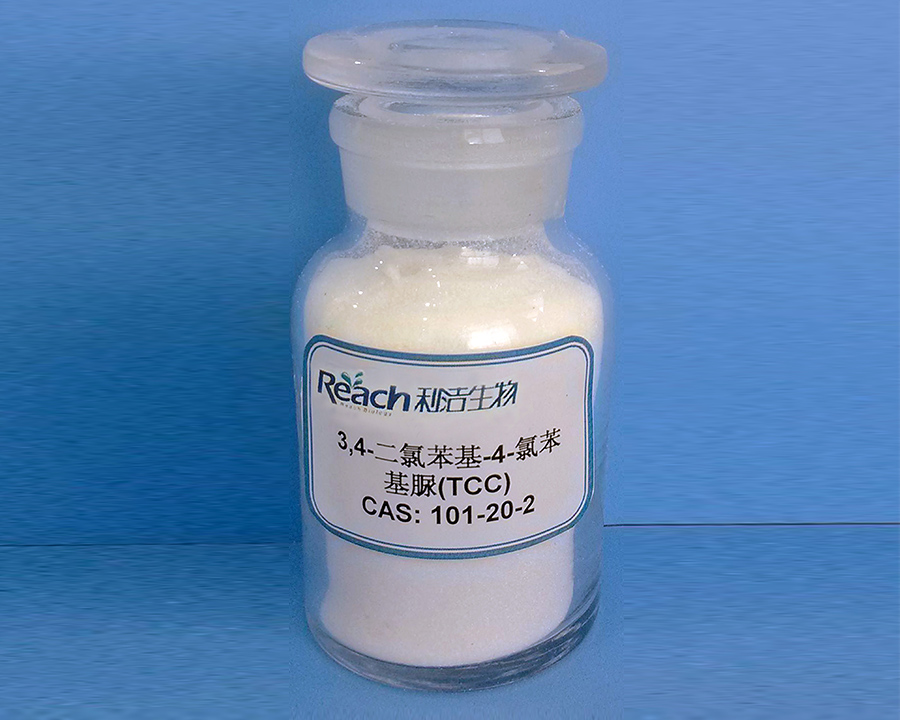
Triclocarban (TCC)

Triclocarban Chemical Structure

1. Product Information

Product Name Triclocarban
Common Name/Synonym TCC
Chemical Name 3,4,4'-Trichlorocarbanilide
IUPAC Name 1-(4-Chlorophenyl)-3-(3,4-dichlorophenyl)urea
Molecular Formula C₁₃H₉Cl₃N₂O
Molecular Weight 315.6 g/mol
CAS Number 101-20-2
EC Number 202-924-1

2. Product Characteristics

Property Specification
Appearance White crystalline powder with faint odor
Antimicrobial Spectrum Broad-spectrum; effective against Gram-positive bacteria, Gram-negative bacteria, fungi, yeasts, and viruses
Mechanism of Action Inhibits microbial fatty acid synthesis and disrupts cell membrane integrity, leading to cell death
Stability Stable to light and heat; chemically stable; does not decompose easily
Solubility Slightly soluble in water (0.11 mg/L at 20-25°C); soluble in ethanol (10 g/L), isopropanol (10 g/L), dipropylene glycol (48 g/L), fatty alcohol polyglycol (100 g/L)
Physical & Chemical Data:
  • Melting Point: 254-256°C (decomposes)
  • Vapor Pressure (25°C): 3.6×10⁻⁹ mmHg / 4.8×10⁻⁷ Pa
  • Density: 1.53 g/cm³
  • Log Kow: 4.9
  • Decomposition Temperature: >250°C

3. Quality Standards

Parameter Specification Test Method
Appearance White crystalline powder Visual
Odor Faint odor Organoleptic
Purity (HPLC) ≥98.0% (Technical) / ≥99.0% (Pharma) HPLC
Melting Range 254°C-256°C (decomposes) Capillary Method
Moisture (Karl Fischer) ≤0.5% KF Titration
Residue on Ignition ≤0.1% Gravimetric
Heavy Metals (as Pb) ≤0.002% Colorimetric
Arsenic (As) ≤0.0001% AAS
Dioxin Impurities Compliant with EU limits GC-MS
Identification IR spectrum matches reference standard FTIR
Note: Pharmaceutical grade meets stricter specifications than technical grade. Custom specifications available upon request.

4. Antimicrobial Activity (MIC Values)

Microorganism MIC (mg/L) Microorganism MIC (mg/L)
Trichophyton sp. 500 Chaetomium globosum 100
Bacillus subtilis ATCC 11774 35-50 Enterococcus faecalis ATCC 19433 50
Escherichia coli EHEC DSM 8579 1000 Lactobacillus fermentum ATCC 14931 50
Legionella pneumophila ATCC 33152 <10 Micrococcus luteus ATCC 7468 5-10
Mycobacterium ATCC 11758 <0.05 Salmonella choleraesuis DSM 4224 1000
Staphylococcus aureus ATCC 6538 10-50 Staphylococcus haemolyticus ATCC 29970 50
Note: Triclocarban shows extremely strong antimycobacterial activity with MIC <0.05 mg/L against Mycobacterium; significant antibacterial effect against Micrococcus luteus with MIC 5-10 mg/L.

5. Applications

5.1 Personal Care & Cosmetics
  • Bar Soap: Primary application for antibacterial deodorant
  • Shampoo/Shower Gel: Antibacterial cleansing
  • Hand Wash/Facial Cleanser: Daily antibacterial care
  • Beauty Serum/Acne Cream: Skincare antimicrobial
  • Shaving Foam: Shaving care
  • Toothpaste/Mouthwash: Oral antimicrobial
  • Laundry Detergent/Fabric Softener: Fabric antimicrobial
  • Wound Ointment: Wound care
  • Cosmetics: Preservative for beauty products
  • Maximum Permitted Concentration: 0.2% (w/w)
5.2 Household & Industrial
  • Antibacterial Dishwashing Detergent: Dish cleaning
  • Textile Antimicrobial Finishing: Fabric antibacterial treatment
  • Medical Disinfectants: Medical device disinfection
  • Fiber Textiles: Antibacterial treatment
  • Deodorant Products: Body odor and foot odor control
5.3 Special Efficacy
  • Deodorizing Effect: Particularly effective against skin bacteria that decompose perspiration and urine
  • Long-lasting Protection: Good affinity with skin proteins provides persistent antimicrobial effect

6. Regulatory Compliance & Safety

Certification/Regulation Details
China Cosmetics Regulation Technical Safety Standard for Cosmetics 2015 Edition: Maximum 0.2%; restricted to rinse-off products only
US FDA September 2016: Banned in hand washes and body washes
Canada Gradually phased out or explicitly banned
EU Restricted use; must comply with relevant regulatory requirements
Toxicity Data:
Endpoint Value
Acute Oral LD₅₀ (Rat) >2000 mg/kg
Acute Oral LD₅₀ (Mouse) >5000 mg/kg
Acute Dermal LD₅₀ (Rabbit) 10000 mg/kg
LC₅₀ (Rainbow trout, 96h) 0.12 mg/L
LC₅₀ (Fathead minnow, 96h) 0.092 mg/L
LC₅₀ (Water flea, 48h) 0.0077-0.020 mg/L
Safety Precautions:
  • Strongly lipophilic; capable of bioaccumulation and biomagnification in organisms
  • Highly toxic to aquatic organisms
  • May cause cancer, reproductive dysfunction, and developmental abnormalities in mammals
  • Can induce DNA damage in human liver cells
  • Gradually phased out or explicitly banned in cleansing and personal care consumer products in Canada and the United States

7. Packaging & Storage

Packaging: 25kg fiber drum (PE-lined) / 1kg aluminum foil bag; customized packaging available
Storage: Cool, dry place (≤25°C); sealed, protected from light; away from strong acids, strong bases, and oxidizers
Shelf Life: 24 months (unopened)
Transport: Handle as general chemical; load/unload carefully to prevent package damage

8. Key Advantages

Copyright © Hunan Lijie Bio Group Co., Ltd. All Rights Reserved  湘ICP备14008251号-1   Powered by Shixin Web Solutions