| Property | Specification |
|---|---|
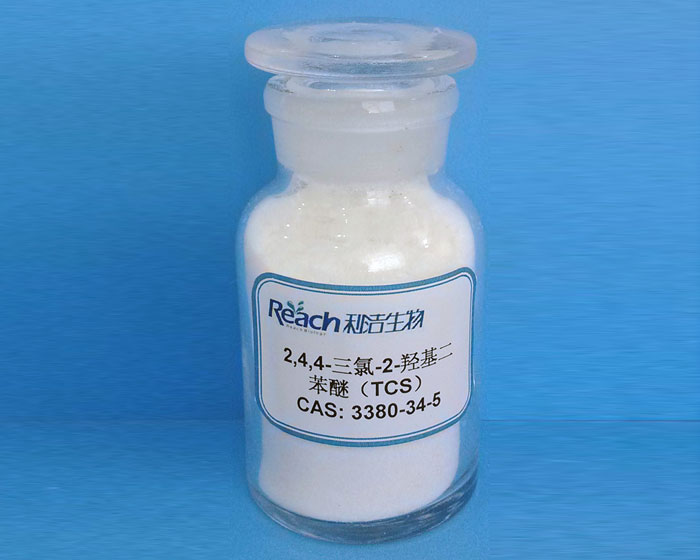
| Appearance | White fine crystalline powder with faint aromatic odor |
| Antimicrobial Spectrum | Broad-spectrum; effective against Gram-positive bacteria, Gram-negative bacteria, molds, yeasts, and viruses |
| Mechanism of Action | Non-ionic compound; adsorbs to bacterial cell wall, penetrates and reacts with cytoplasmic lipids and proteins causing irreversible denaturation |
| Stability | Low volatility at ambient temperature; stable below 280-290°C; only 2% decomposition after heating at 200°C for 14h; slight decomposition under UV light |
| Solubility | Slightly soluble in water (0.01 g/L at 20°C); readily soluble in ethanol, isopropanol, propylene glycol, ethyl acetate, and alkaline solutions |
| Parameter | Specification | Test Method |
|---|---|---|
| Appearance | White fine crystalline powder | Visual |
| Odor | Faint aromatic odor | Organoleptic |
| Purity (HPLC) | ≥98.0% (Technical) / ≥99.0% (Pharma) | HPLC |
| Melting Range | 56°C-58°C | Capillary Method |
| Moisture (Karl Fischer) | ≤0.1% | KF Titration |
| Residue on Ignition | ≤0.1% | Gravimetric |
| Heavy Metals (as Pb) | ≤0.002% | Colorimetric |
| Arsenic (As) | ≤0.0001% | AAS |
| Dioxin Impurities | Compliant with EU limits | GC-MS |
| Identification | IR spectrum matches reference standard | FTIR |
| Microorganism | MIC (mg/L) | Microorganism | MIC (mg/L) |
|---|---|---|---|
| Staphylococcus aureus | 0.01-0.1 | Escherichia coli | 0.1-1.0 |
| Bacillus subtilis | 0.01-0.1 | Pseudomonas aeruginosa | 0.5-5.0 |
| Candida albicans | 0.1-1.0 | Aspergillus niger | 1.0-10.0 |
| Trichophyton mentagrophytes | 0.1-1.0 | Saccharomyces cerevisiae | 0.5-5.0 |
| Certification/Regulation | Details |
|---|---|
| China Cosmetics Regulation | Technical Safety Standard for Cosmetics 2015 Edition: Maximum 0.3%; restricted to hand soap, bath soap, body wash, deodorant (non-spray), face powder/concealer, and nail cleanser (frequency not exceeding once per 2 weeks) |
| EU Regulations | January 2014: Triclosan removed from Annex V of Regulation (EC) No. 1223/2009; restricted as cosmetic preservative; EU SCCS considers 0.3% maximum concentration safe in toothpaste, hand soap, soap/shower gel, and deodorant |
| US FDA | September 2016: Banned in hand washes and body washes; still permitted in toothpaste |
| Other Applications | Still permitted in non-cosmetic fields such as medical devices and industry |
| Endpoint | Value |
|---|---|
| Acute Oral LD₅₀ (Rat) | >5000 mg/kg (Practically non-toxic) |
| Acute Dermal LD₅₀ (Rabbit) | >6000 mg/kg |
| Skin Irritation | No acute or chronic toxicity |
| Special Risks | Reacts with chlorine-containing bleaches to form toxic chlorinated derivatives; may produce carcinogenic substances upon UV exposure or heating |

