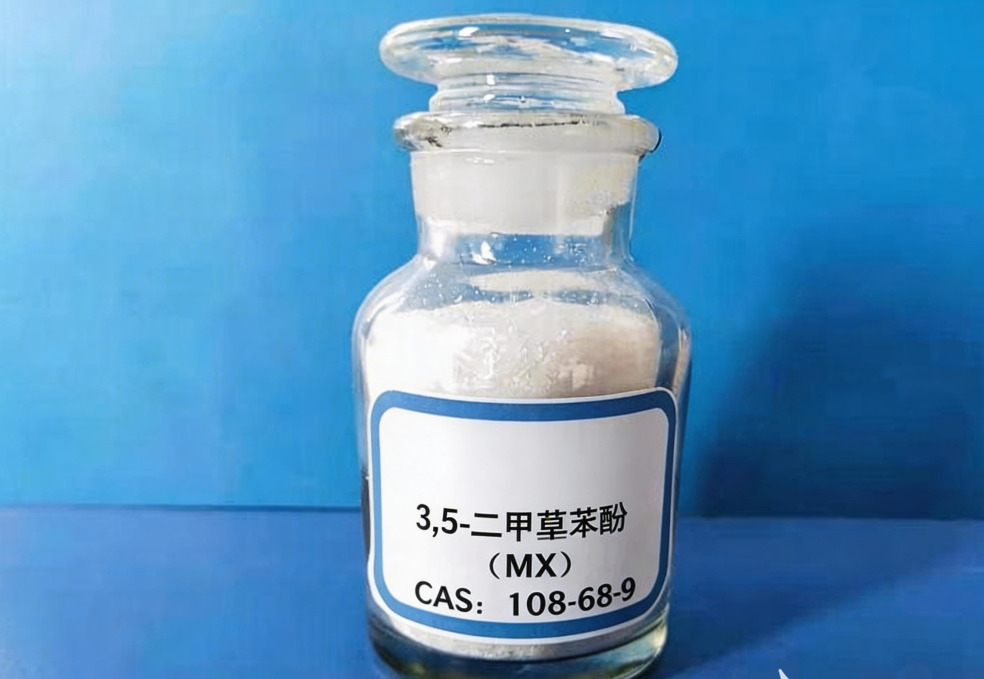
MX (3,5-Xylenol)

MX Chemical Structure

1. Product Information

Product Name 3,5-Dimethylphenol
Common Name/Synonym MX / 3,5-Xylenol
IUPAC Name 3,5-Dimethylphenol
Synonyms 3,5-Xylenol; m-Xylenol
Molecular Formula C₈H₁₀O
Molecular Weight 122.16 g/mol
CAS Number 108-68-9
EC Number 203-607-0

2. Product Characteristics

Property Specification
Appearance White to pale yellow needle-like crystals or solid with characteristic phenolic odor
Chemical Properties Important organic synthesis intermediate; hydroxyl group undergoes nucleophilic substitution to form esters, ethers, and amides
Solubility Slightly soluble in water (5 g/L at 25°C); readily soluble in alcohols, ethers, acetone, and alkaline solutions
Stability Stable at ambient temperature; volatile; store sealed and protected from light
Reactivity Capable of chlorination, amination, and alkylation reactions; key raw material for high-value-added derivatives
Physical & Chemical Data:
  • Boiling Point: 219.5°C (760 mmHg) / 222°C
  • Melting Point: 62-66°C (64°C)
  • Flash Point: 80°C
  • Vapor Pressure (25°C): 0.05 hPa
  • pKa: 10.19 (25°C)
  • Log Kow: 2.35

3. Quality Specifications

Parameter Specification Test Method
Appearance White to pale yellow needle-like crystals or solid Visual
Odor Characteristic phenolic odor Organoleptic
Purity (GC) ≥99.0% (Premium) / ≥98.5% (Technical) GC
Melting Range 62°C - 66°C (63-65°C) Capillary Method
Moisture (Karl Fischer) ≤0.2% KF Titration
Residue on Ignition ≤0.1% Gravimetric
Other Phenolic Impurities ≤1.0% (other xylenols) GC
m-Cresol ≤0.1% GC
Iron (Fe) ≤80 ppm AAS
Solution Clarity Clear and transparent Visual
Identification IR spectrum matches reference standard FTIR
Note: Premium grade meets stricter specifications than technical grade. Custom specifications available upon request.

4. Antimicrobial Activity (MIC Values)

Microorganism MIC (mg/L) Microorganism MIC (mg/L)
Escherichia coli 500 Staphylococcus aureus 1000
Aspergillus niger 500 Chaetomium globosum 500
Penicillium sp. 500 - -
Note: 3,5-Xylenol exhibits antimicrobial activity against common microorganisms but is less potent than PCMX and DCMX. Primarily used as a synthesis intermediate rather than a terminal biocide.

5. Applications

5.1 Pesticides & Insecticides
  • Methomyl intermediate: Key raw material for carbamate insecticide methomyl
  • Methiocarb intermediate: Precursor for 4-methylthio-3,5-dimethylphenol via chlorination and methylthiolation; used in methiocarb production
5.2 Pharmaceutical Intermediates
  • PCMX/DCMX precursor: Chlorination yields 4-chloro-3,5-dimethylphenol (PCMX) and 2,4-dichloro-3,5-dimethylphenol (DCMX) for high-performance disinfectants and preservatives
  • 2,3,5-Trimethylphenol: Alkylation with methanol produces trimethylphenol for pharmaceutical synthesis
  • 3,5-Xylidine: Amination produces xylidine for advanced dye synthesis
5.3 Industrial Chemicals
  • Rubber Industry: Rubber accelerators, antioxidants, and anti-aging agents
  • Coatings & Inks: Advanced printing inks, coatings, and phenolic resin synthesis
  • Plastics & Plasticizers: DBP plasticizer, Bakelite (phenolic resin), and engineering plastics monomers
  • Lubricant Additives: Additives for cold rolling oils and non-toxic flame-resistant turbine oils; significantly extends service life
5.4 Personal Care & Fragrances
  • Antioxidants: Formulations for industrial and personal care applications
  • Fragrance Synthesis: Precursor for specific fragrance compounds
  • Disinfectants: Moderate antimicrobial activity at low concentrations for general sanitation
5.5 Other Applications
  • Explosives: Component in certain explosive formulations
  • Dyes: Intermediate for advanced dye synthesis
  • GC Standard: Reference material for simultaneous determination of phenol, cresols, and xylenol isomers

6. Safety & Toxicity Data

Endpoint Value
Acute Oral LD₅₀ (Rat) 608 mg/kg (Toxic)
Acute Oral LD₅₀ (Mouse) 477 mg/kg
Acute IP LD₅₀ (Mouse) 156 mg/kg
Acute Oral LD₅₀ (Rabbit) 1313 mg/kg
Skin Irritation Corrosive; protective measures required
Eye Irritation Severe eye irritant
Aquatic Toxicity Harmful to aquatic organisms
Hazard Classification Toxic substance; corrosive
Safety Precautions:
  • Appropriate protective measures must be taken during production and handling to avoid direct skin and eye contact
  • Store in a cool, ventilated area away from strong acids, strong bases, and strong oxidizers
  • Personnel must wear protective gloves, safety goggles, and respirators

7. Packaging & Storage

Packaging: 200kg/iron drum; 25kg/fiber drum (PE-lined); customized packaging available
Storage: Cool, dry place (≤25°C); sealed, protected from light; away from ignition sources, strong acids, strong bases, and oxidizers
Shelf Life: 24 months from production date; product may be used after retest if stored beyond expiry
Transport: Handle as hazardous chemical; load/unload carefully to prevent package damage

8. Key Advantages

Copyright © Hunan Lijie Bio Group Co., Ltd. All Rights Reserved  湘ICP备14008251号-1   Powered by Shixin Web Solutions