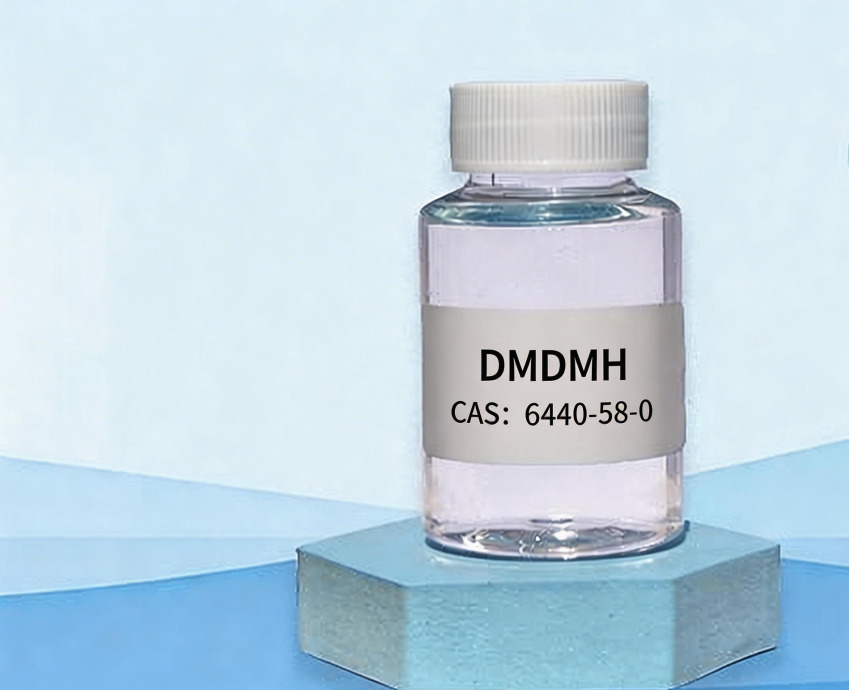
1,3-Dihydroxymethyl-5,5-dimethylhydantoin (DMDMH)

DMDMH Chemical Structure

I. Product Information

Product Name 1,3-Dihydroxymethyl-5,5-dimethylhydantoin
Synonyms DMDMH
Chemical Name 1,3-Bis(hydroxymethyl)-5,5-dimethylimidazolidine-2,4-dione
IUPAC Name 1,3-bis(hydroxymethyl)-5,5-dimethylimidazolidine-2,4-dione
INCI Name DMDM Hydantoin
Molecular Formula C₇H₁₂N₂O₄
Molecular Weight 188.2
CAS No. 6440-58-0
EC Number 229-222-8

II. Product Properties

Property Description
Appearance White odorless powder (pure); colorless transparent liquid (55% commercial grade)
Antimicrobial Spectrum Broad-spectrum efficacy against Gram-positive/negative bacteria, yeast, and mold
Mechanism Dual action: ① Slowly releases formaldehyde for antimicrobial effect; ② N-hydroxymethyl group itself is an active antimicrobial moiety
Stability Pure product stable at pH 6~8; 55% solution heat stable (up to 80℃), stable at pH 6.5~7.5; avoid reaction with amines or thiols under alkaline conditions
Solubility Water 773 g/L (completely miscible); ethanol 564 g/L; hexane 0.2 g/L; excellent compatibility with cosmetic and detergent ingredients
Physical & Chemical Data:
  • Boiling Point: 198~200℃ (decomposes on boiling)
  • Melting Point: 90℃ (OECD)
  • Vapor Pressure (25℃): 9.0×10⁻⁶ mmHg
  • Density: 0.4 g/cm³ (21℃, pure) / 1.16 g/mL (25℃, 55% solution)
  • lgKow: -2.9 (extremely hydrophilic)
  • Flash Point: >100℃
  • Freezing Point (55% solution): -11℃
  • Nitrogen Content: 8.04%~8.34%

III. Quality Specifications

Test Item Specification Method
Appearance White odorless powder (pure) / Colorless transparent liquid (55% solution) Visual
Active Content 55%±2% (solution) / ≥99% (pure) Titration
Aldehyde Content 17%~19% (as formaldehyde, 55% solution) Sodium Sulfite Method
pH (20℃) 6.5~7.5 (55% solution) / 6~8 (pure) pH Meter
Density (25℃) 1.16 g/mL (55% solution) Densitometry
Freezing Point ≤-11℃ (55% solution) Freezing Point Method
Flash Point >100℃ Closed Cup
Heavy Metals (as Pb) ≤0.001% Colorimetric
Free Formaldehyde ≤1% (controlled at low level) Acetylacetone Method
Identification IR spectrum matches reference standard FTIR
Note: Available as 55% solution, pure powder, and other specifications upon request.

IV. Antimicrobial Performance (MIC Data)

Microorganism MIC (mg/L) Microorganism MIC (mg/L)
Aspergillus niger 1455 Bacillus subtilis 727
Aspergillus flavus 1550 E. coli 291
Saccharomyces cerevisiae 1300 S. aureus 29
Brewer's yeast 1455 P. aeruginosa 291
Note: DMDMH shows excellent inhibition against Gram-positive bacteria (S. aureus MIC 29 mg/L); relatively weaker against mold and yeast (MIC 1300~1550 mg/L), requiring combination with other preservatives.

V. Applications

1. Cosmetics & Personal Care (Core Application)
  • Shampoos: Preservation; widely used in combination with IPBC or parabens
  • Conditioners/Shaving products: Mild preservation
  • Foundations/Lotions: Aqueous product preservation
  • Creams/Baby products: Low-irritation formulations
  • Sunscreens/Cleansers: Rinse-off products
  • Features: No skin or mucous membrane irritation; excellent hydrophilicity and compatibility with cosmetic/detergent ingredients
2. Coatings & Aqueous Polymers
  • Water-based coatings: Anti-mold and preservation
  • Water-based adhesives: Microbial contamination prevention
  • Dyes/Pigments: Preservation
  • Printing auxiliaries: Preservation
3. Metalworking & Industrial
  • Metal cutting fluids: Preservation (PT-13 type)
  • Industrial circulating water: Biocidal preservation
  • Oilfield water injection: Anti-corrosion treatment
4. Textiles & Fibers
  • Textile auxiliaries: Preservation
  • Fiber fabrics: US Patent 6077319 discloses etherification of DMDMH to fiber surfaces followed by chlorination to impart antimicrobial properties
5. Other Industries
  • Inks: Preservation
  • Paraffin oils: Preservation
  • Wood: Anti-mold treatment
  • Leather: Preservation

VI. Regulatory Compliance & Safety

Certification/Regulation Details
EU ECHA Approval applications submitted under Directive 98/8/EC (BPD) or Regulation (EU) No.528/2012 (BPR) for PT-6 (In-can preservatives) and PT-13 (Metalworking fluids); currently under review
Cosmetic Applications Globally recognized cosmetic preservative with over 30 years of use history
US Patent US 6077319: Antimicrobial treatment method for fiber fabrics
Toxicity Data:
Endpoint Data
Rat acute oral LD₅₀ 2000 mg/kg
Rabbit acute dermal LD₅₀ >2000 mg/kg
Rat inhalation LC₅₀ (4h) >377.8 mg/L
Rainbow trout LC₅₀ (96h) 283 mg/kg
Bluegill LC₅₀ (96h) 95 mg/kg
Daphnia EC₅₀ (48h) 20.4 mg/L
Skin Irritation No skin or mucous membrane irritation
Usage Precautions:
  • Formaldehyde is highly reactive and may react with amine- or thiol-containing surfactants or emulsifiers under alkaline conditions, affecting preservation efficacy
  • Avoid direct contact with strong alkaline substances
  • Recommended for use in combination with IPBC or parabens to enhance inhibition against mold and yeast

VII. Packaging & Storage

Packaging: 200kg/plastic drum (55% solution) / 25kg/fiber drum (pure); custom sizes available
Storage: Cool, dry place (≤25°C), sealed, away from light; avoid contact with amines, thiols, and strong alkalis
Shelf Life: 24 months (sealed)
Transport: General chemical; handle with care to prevent damage

VIII. Key Advantages

Copyright: Hunan LiJie Biotech Group Co., Ltd.  湘ICP备14008251号-1   Powered by Shixin CMS