| Property | Description |
|---|---|
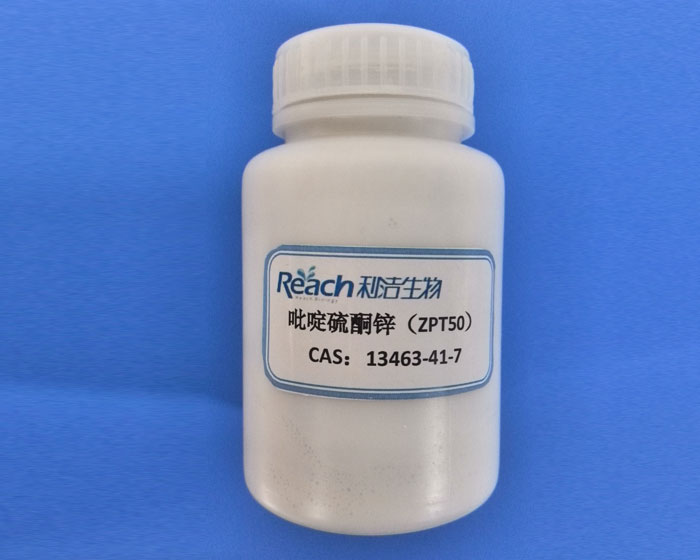
| Appearance | White to off-white powder (pure) |
| Antimicrobial Spectrum | Broad-spectrum efficacy against molds, bacteria, and yeast; stronger inhibition against Gram-positive than Gram-negative bacteria |
| Mechanism | Ion gradient disruption: Under neutral/acidic conditions, transports K⁺ out and H⁺ into bacterial cells; under alkaline conditions, transports K⁺ or Mg²⁺ out and Na⁺ in, effectively "starving" cells by eliminating nutrient ion gradients |
| Stability | Stable at pH 4.5~9.5; excellent thermal stability (stable for at least 120h at 100℃); gradually degrades under UV; converts to mercaptopyridine below pH 3.5; may form soluble basic salts above pH 8.5 |
| Solubility | Water (pH 7) 0.008 g/L; ethanol 0.1 g/L; propylene glycol 0.2 g/L; isopropanol 0.08 g/L; PEG 2 g/L; chloroform 3 g/L; DMF 80 g/L |
| Test Item | Specification | Method |
|---|---|---|
| Appearance | White to off-white powder | Visual |
| Content (as Zn) | 9.8%~11.2% | AAS |
| pH (5% suspension) | 6.5~8.5 | pH Meter |
| Loss on Drying | ≤0.5% | Gravimetric |
| Residue (325 mesh) | ≤0.1% | Sieving |
| Heavy Metals (as Pb) | ≤0.002% | Colorimetric |
| Arsenic (As) | ≤0.0001% | AAS |
| pH Stability | Stable at pH 4.5~9.5 | pH Meter |
| Thermal Stability | Stable for 120h at 100℃ | Thermal Stability Test |
| Identification | IR spectrum matches reference standard | FTIR |
| Microorganism | MIC (mg/L) | Microorganism | MIC (mg/L) |
|---|---|---|---|
| S. aureus 6538 | 4 | Enterococcus faecalis 19433 | 16 |
| E. coli 9637 | 8 | P. aeruginosa 9721 | 512 |
| Klebsiella pneumoniae 4352 | 8 | Fusarium | 32 |
| Aspergillus niger 9642 | 8 | Aureobasidium pullulans 9348 | 2 |
| Chaetomium globosum 6205 | 2 | Gliocladium virens 9645 | 64 |
| Penicillium funiculosum 9644 | 2 | C. albicans 11651 | 2 |
| Sporotrichum olivaceum | 4 | Trentepohlia (aerial algae) | 0.06 |
| Chlorococcum | 8 | Scytonema | 0.5 |
| Certification/Regulation | Details |
|---|---|
| China Cosmetics Regulations | "Cosmetics Safety Technical Specifications" 2015: Max 0.5%; restricted to rinse-off products |
| US FDA | 1981 approval of 29 ZPT-containing formulations; considered safe for daily use at 1%~2% in shampoos |
| EU ECHA | Approval applications submitted under Directive 98/8/EC (BPD) or Regulation (EU) No.528/2012 (BPR) for PT-2, PT-6, PT-7, PT-9, PT-10, PT-21; currently under review |
| Coatings Standard | GB/T 35602-2017 "Green Product Assessment - Coatings" limits ZPT to ≤0.5% in coatings |
| Endpoint | Data |
|---|---|
| Mouse acute oral LD₅₀ | 361 mg/kg (Toxic) |
| Rabbit acute dermal LD₅₀ | >2000 mg/kg |
| Mouse intraperitoneal LD₅₀ | 22.5 mg/kg |
| Mouse oral LD₅₀ | 260 mg/kg |
| IP toxicity vs oral toxicity | IP toxicity approximately 10× higher than oral |
| Rat 540 mg/kg daily oral | After 1 week: reduced appetite, decreased activity, unkempt fur, weight loss; after 30 days: no significant pathology except cloudy swelling and vacuolation in hepatocytes of high-dose group |
| Aquatic toxicity | Rainbow trout LC₅₀ (96h): 3.2 μg/L; Daphnia EC₅₀ (48h): 34 μg/L |

