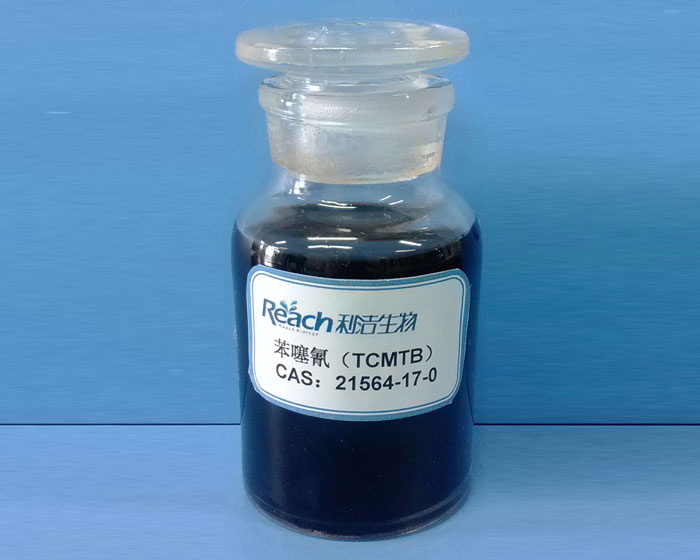
TCMTB (2-(Thiocyanomethylthio)benzothiazole)

TCMTB Chemical Structure

I. Product Information

Product Name TCMTB
Synonyms Thiocyanomethylthiobenzothiazole
Chemical Name 2-(Thiocyanomethylthio)benzothiazole
IUPAC Name 1,3-benzothiazol-2-ylsulfanylmethyl thiocyanate
Molecular Formula C₉H₆N₂S₃
Molecular Weight 238.4
CAS No. 21564-17-0
EC Number 244-445-0

II. Product Properties

Property Description
Appearance Yellow crystals or oily liquid (pure); brown-red oily liquid (80% TC); available as 60% and 30% formulations
Antimicrobial Spectrum Broad-spectrum efficacy against bacteria, molds, and yeast; especially effective against Aspergillus niger, Penicillium citrinum, Aspergillus flavus, Penicillium chrysogenum, Trichoderma, and most molds
Mechanism Thiocyanate group reacts with microbial enzyme systems, inhibiting cellular respiration and energy metabolism
Stability Decomposes under alkaline conditions; decomposes above 130°C; excellent stability to temperature, pH, and UV (when combined with glutaraldehyde)
Solubility Water 0.03 g/L (slightly soluble); readily soluble in acetone, DMF, toluene; isopropanol <0.5 g/L; ethylene glycol <0.5 g/L; propylene glycol <0.5 g/L
Physical & Chemical Data:
  • Density (22℃): 1.38 g/mL (pure)
  • Vapor Pressure (25℃): 4.75×10⁻⁶ hPa / <0.01 mmHg (TC)
  • lgKow: 3.30
  • Flash Point: ≥120.7℃
  • DT₅₀ (Biodegradation in water): 2.8 days
  • Active Ingredient (TC): 80%

III. Quality Specifications

Test Item Specification Method
Appearance Yellow crystals or oily liquid (pure) / Brown-red oily liquid (80% TC) Visual
Active Ingredient ≥80% (TC) / 60%±2% (formulation) / 30%±1% (formulation) GC
Density (22℃) 1.38 g/mL (pure) Densitometry
Vapor Pressure (25℃) 4.75×10⁻⁶ hPa Vapor Pressure Method
Flash Point ≥120.7℃ Closed Cup
Moisture ≤0.5% Karl Fischer
pH Stability Decomposes under alkaline conditions pH Meter
Thermal Stability Decomposes above 130°C TGA
Biodegradability (DT₅₀) 2.8 days (water) OECD 301B
Heavy Metals (as Pb) ≤0.002% Colorimetric
Identification IR spectrum matches reference standard FTIR
Note: Available as 80% TC, 60% formulation, 30% formulation, and other custom specifications.

IV. Antimicrobial Performance (MIC Data)

Microorganism MIC (mg/L) Microorganism MIC (mg/L)
Aspergillus niger 3 Bacillus megaterium 50
Aspergillus flavus 3 E. coli 20
Aspergillus versicolor 3 S. aureus 20
Chaetomium globosum 1 B. subtilis 50
Cladosporium herbarum 3 Pseudomonas fluorescens 50
Penicillium citrinum 3 P. aeruginosa 50 (4h) / 20 (24h)
Paecilomyces variotii 3 Saccharomyces cerevisiae 10
Trichoderma viride 20
Note: TCMTB shows excellent antifungal activity with MIC values of 1-3 mg/L against A. niger, A. flavus, and P. citrinum.
Synergistic Effect with Glutaraldehyde (vs P. aeruginosa):
Ratio (TCMTB:Glutaraldehyde) MIC 4h (mg/L) SI (Synergy Index) MIC 24h (mg/L) SI (Synergy Index)
19:1 90 1.29 40 0.64
9:1 80 1.20 40 0.71
4:1 50 1.00 40 0.85
1:1 20 0.63 20 0.64
1:4 20 0.85 20 0.85
1:9 10 0.46 20 0.92
TCMTB alone 80 (4h) / 70 (24h) - - -
Glutaraldehyde alone 20 - 20 -
Note: SI<1 indicates synergy, SI=1 indicates additivity, SI>1 indicates antagonism; TCMTB and glutaraldehyde show significant synergistic effects at ratios 19:1 to 1:9, with optimal ratio 1:1 to 1:4.

V. Applications

1. Agriculture
  • Seed treatment: Cotton, corn, barley, rice, wheat, sorghum, sugar beet, and other crop seeds
  • Soil-borne disease control: Prevention and treatment of soil-transmitted diseases
  • Function: Protects seeds from mold and bacteria, improving germination rates and crop yields
2. Industrial Water Treatment
  • Cooling water systems: Microbial control in heat exchange systems, preventing biofouling, flow reduction, and increased energy consumption
  • Features: Low volatility, excellent stability to temperature, pH, and UV, compatible with other water treatment chemicals
  • Combined application: With glutaraldehyde (ratio 19:1 to 1:9, dosage 1-100 mg/kg), showing significant synergistic effects at 4h and 24h exposure
3. Leather Industry
  • Leather tanning: Prevents bacterial action during early stages (curing and soaking) and fungal action during later stages
  • Fur preservation: Short-term preservation of salt-free leather and fur; prevents bacterial damage to pickled or tanned leather products
  • Features: No adverse effects on leather quality; does not affect final product color or physical properties
4. Wood Preservation
  • Wood processing: Inhibits bacteria and fungi attacking wood
  • Surface coatings: Non-volatile; soluble in organic solvents or dispersible in water
  • Metal-friendly: Non-corrosive to steel and copper; no discoloration or staining; compatible with nitrocellulose lacquers and varnishes
  • Applications: Wood processing industry and surface coating sector
5. Papermaking Industry
  • Pulp preservation: Prevents microbial contamination
  • Anti-mold paper: Production of mold-resistant paper
6. Coatings Industry
  • Coating preservation: Anti-mold and antimicrobial protection for industrial coatings and paints
  • Features: Does not affect coating color or gloss

VI. Regulatory Compliance & Safety

Certification/Regulation Details
Toxicity Data (TC) Rat acute oral LD₅₀: 2664 mg/kg; Rabbit acute dermal LD₅₀: 2000 mg/kg
Sub-chronic Toxicity Rat sub-chronic oral NOEL: 500 mg/kg; Dog sub-chronic oral NOEL: 333 mg/kg
Teratogenic/Mutagenic/Carcinogenic No teratogenic, mutagenic, or carcinogenic effects observed at test doses
Skin Irritation Irritating to rabbit eyes and skin
Aquatic Toxicity Carp LC₅₀ (48h): 0.125-0.25 mg/L; Rainbow trout LC₅₀ (96h): 0.029 mg/L
Biodegradability DT₅₀ (water): 2.8 days; readily biodegradable
Environmental Profile Rapid degradation in water; environmentally friendly
Safety Precautions:
  • Irritating to eyes and skin; wear protective equipment during handling
  • Highly toxic to aquatic organisms; avoid direct discharge into water bodies
  • Decomposes under alkaline conditions; avoid mixing with strong alkalis

VII. Packaging & Storage

Packaging: 200kg/iron drum (TC) / 25kg/plastic drum (formulations); custom sizes available
Storage: Cool, dry place (≤25°C), sealed, away from light; avoid strong alkalis and oxidizers
Shelf Life: 24 months (sealed)
Transport: Hazardous chemical (irritant, aquatic environmental hazard); handle with care

VIII. Key Advantages

Copyright: Hunan LiJie Biotech Group Co., Ltd.  湘ICP备14008251号-1   Powered by Shixin CMS