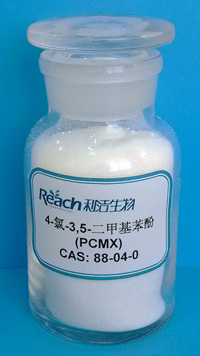
| Property | Specification |
|---|---|
| Appearance | White crystalline powder with slight phenolic odor |
| Antimicrobial Spectrum | Broad-spectrum; effective against 160+ bacteria, viruses, and fungi |
| Safety Profile | FDA-approved topical antimicrobial; low toxicity, non-irritating |
| Stability | Stable at ambient temperature; steam-volatile; stable in hot water |
| Solubility | Soluble in ethanol, isopropanol, benzene, and alkaline solutions |
Quality standards based on industrial and pharmaceutical grades:
| Parameter | Specification | Test Method |
|---|---|---|
| Appearance | White to off-white crystalline powder | Visual |
| Purity (GC) | ≥98.5% (Technical) / ≥99.0% (Pharma) | Gas Chromatography |
| Melting Range | 114°C - 116°C | Capillary Method |
| Moisture (Karl Fischer) | ≤0.5% | KF Titration |
| Residue on Ignition | ≤0.1% | Gravimetric |
| Iron (Fe) | ≤100 ppm (Tech) / ≤50 ppm (Pharma) | AAS |
| Copper (Cu) | ≤100 ppm | AAS |
| Total Impurities | ≤1.5% | GC |
| 3,5-Xylenol (MX) | ≤0.5% | GC |
| 2-Chloro-3,5-xylenol (OCMX) | ≤0.3% | GC |
| 2,4-Dichloro-3,5-xylenol (DCMX) | ≤0.3% | GC |
| Tetrachloroethylene | ≤0.1% | GC |
| Identification | IR spectrum matches reference standard | FTIR |
| Microorganism | MIC (mg/L) | Microorganism | MIC (mg/L) |
|---|---|---|---|
| Aspergillus niger | 50 | Mucor mucedo | 50 |
| Aspergillus flavus | 50 | Bacillus subtilis | 50 |
| Aspergillus versicolor | 50 | Bacillus megaterium | 50 |
| Penicillium citrinum | 50 | Escherichia coli | 250 |
| Paecilomyces variotii | 100 | Pseudomonas fluorescens | >1000 |
| Cladosporium cladosporioides | 50 | Staphylococcus aureus | 50 |
| Trichoderma viride | 50 | Pseudomonas aeruginosa | >1000 |
| Chaetomium globosum | 50 | Saccharomyces cerevisiae | 50 |
| Alternaria alternata | 50 | Candida albicans | 100 |
| Endpoint | Value |
|---|---|
| Acute Oral LD₅₀ (Rat) | 3830 mg/kg (Low toxicity) |
| Acute IP LD₅₀ (Mouse) | 115 mg/kg |
| Acute Dermal LD₅₀ (Rat) | >2000 mg/kg |
| LC₅₀ (Rainbow trout, 96h) | 0.76 mg/L |
| EC₅₀ (Water flea, 48h) | 7.7 mg/L |
| Skin Irritation | Non-irritating (at appropriate concentrations) |
| Sensitization | Non-sensitizing |

